
Decided to install artificial grass yourself? Great! Many projects can be done with quality even if you're not experienced in the field. We've put together a step-by-step guide for a good final result and we're available to help you.
For more complex projects, we recommend consulting us for installation. We have experienced professionals with the right equipment for the most challenging jobs.
Vídeo GUIDE
[youtube:YbL267l99F4]
BEFORE STARTING: PLAN
Before moving forward, measure the land and check the area of grass needed for your project.
Keep in mind that the area of grass required is often larger than the area to be paved due to cuts and waste.
Also, think about whether you want to add other decorative elements or plants and how you want to integrate them into your space.
One thing to keep in mind is the direction of the blades. Except for models with multidirectional blades, for a more natural look, the grass should be installed with the blades facing the house.

ARTIFICIAL GRASS INSTALLATION MANUAL FOR GARDENS
(Note: If your floor is a hard surface, like concrete, go to step 5)
1. Removal of existing natural grass and weeds
- Remove all existing natural grass and/or weeds.
- Dig the ground, if necessary, so that you have a leveled box about 10 cm deep.
- Compact the soil
Tip: Create a slight slope (1-2%) for water drainage.
2. Aplication of weed-proof screen
- Put weed control fabric over the soil.
- Overlap the joints by about 10 cm.
Tip: Securing with metal clips prevents it from lifting in the wind until you finish the next step..
3. Aplication of the stone powder base
- Spread a 10cm layer of damp stone powder and level it. Create a slight slope (1–2%) for water drainage.
- Water abundantly.
- Compact with a vibrating plate.
- Check levels and pending items again and fix them if needed.
Tip: Remove any stones larger than 1cm so that your lawn is as flat as possible and so you won't feel them when walking barefoot. Don't skimp on time at this stage. A well-prepared base is half the battle for a successful installation.
4. Laying the artificial grass
- Unroll the grass.
- Let the grass rest for 1 hour to release stress.
- Adjust your piece to the space. If you need multiple pieces, prepare to join the second piece to the first. Lift both ends of the grass and cut the outer lines in the joining area, between several pieces.
- Adjust the spacing between the pieces and check if the joint is invisible.
- Trim and cut the edges with an X-acto knife (very sharp blade).
Tip: The grass may have some creases due to transport and packaging. You'll see that a little time in the sun will make your grass look perfect.
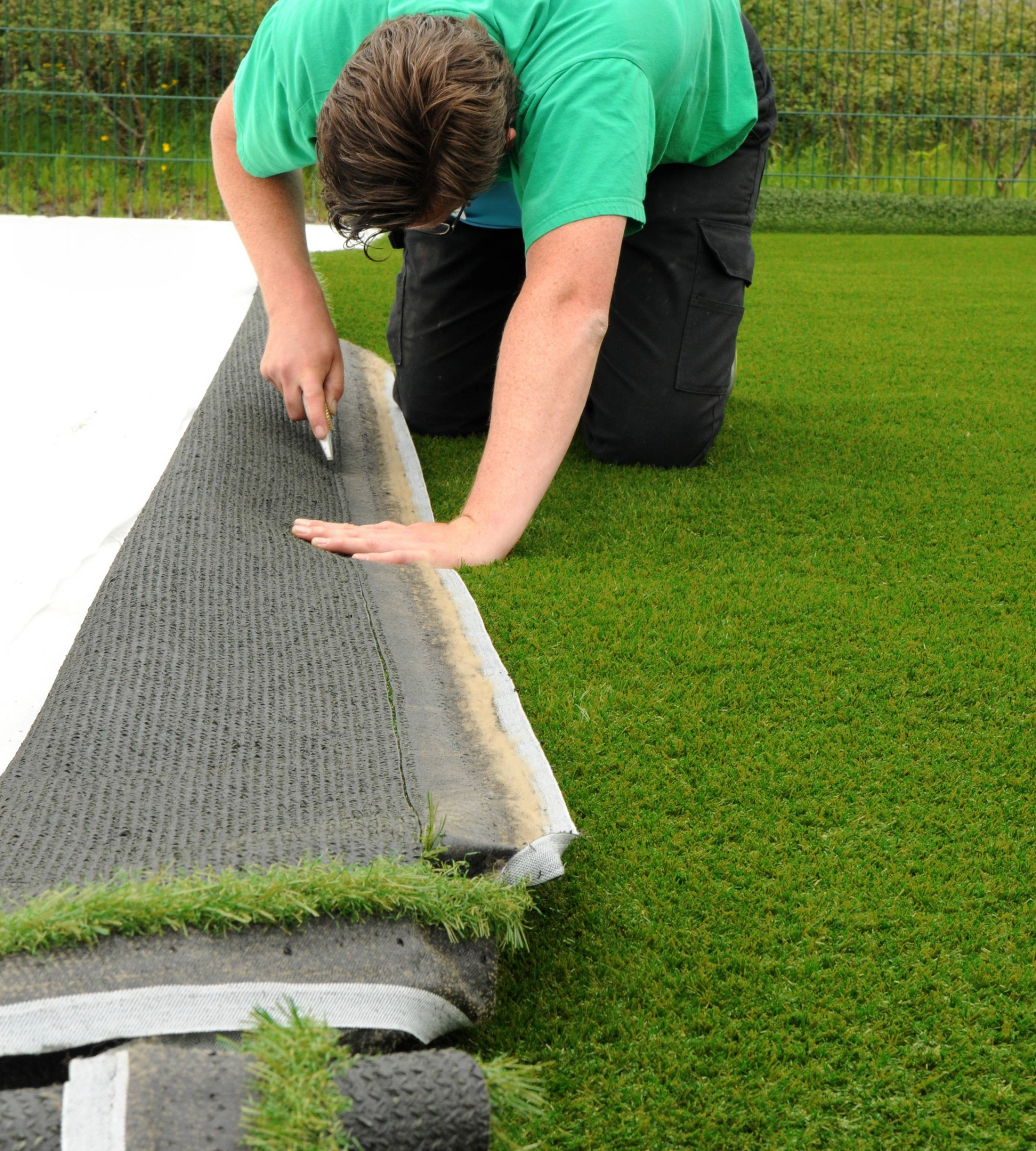
5. Join pieces
- Adjust the spacing between the pieces and check if the joint is invisible
- Place a joining strip between the two pieces.
- Apply glue to the tape (or use adhesive tape).
- Close the joints, check the spacing between parts, and press.
- Let it dry for 24 hours.
Very important: Be careful. The filaments must not touch the glue!
Tip: Too much glue can get on the filaments at the surface when you press. Apply the amount recommended by the supplier and spread it well before joining the pieces.
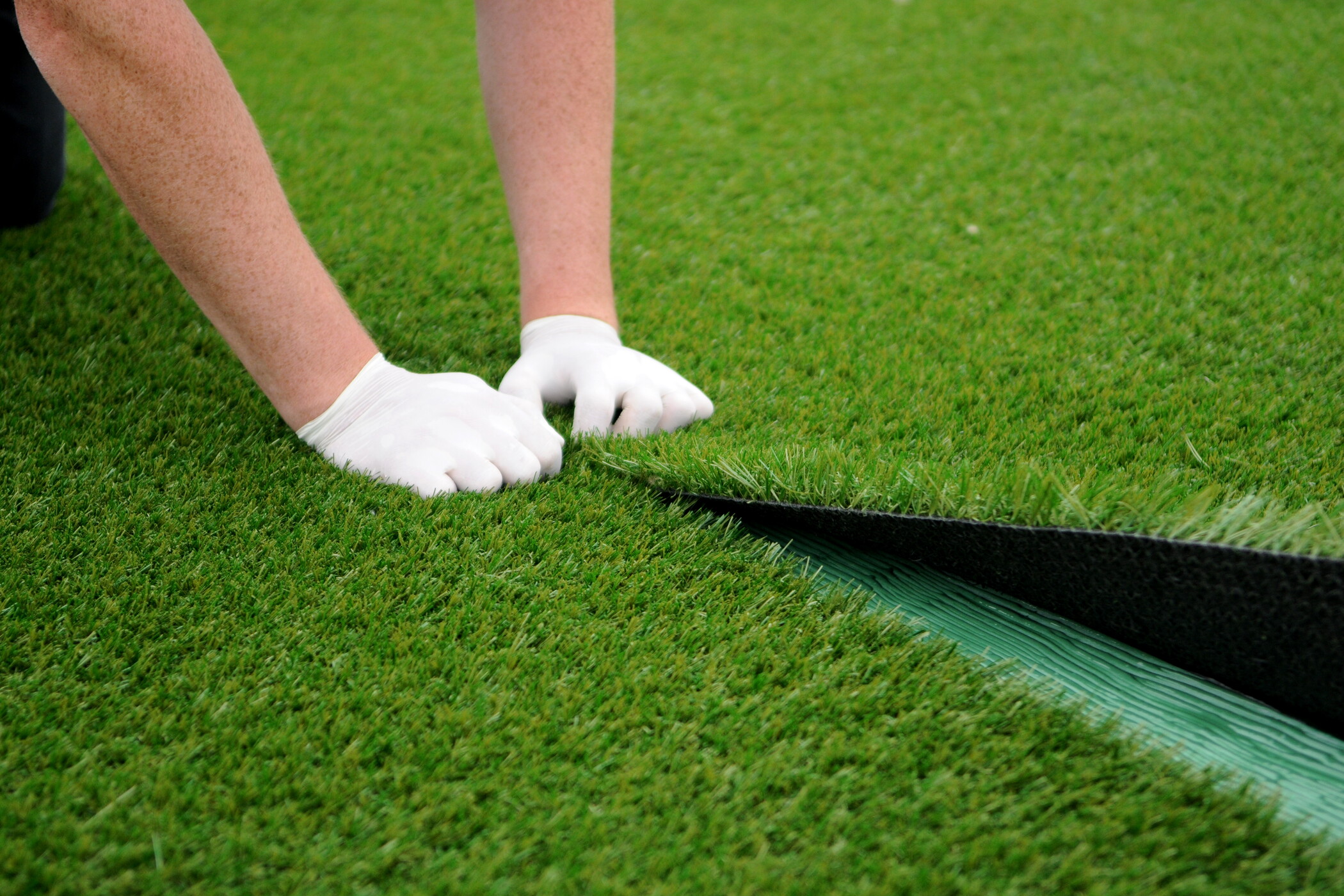
6. Fixation on the perimeter
Fixing it is optional, but if you're dealing with small pieces or areas where the wind could move the turf mats, you should fix it.
There are several options:
- U-shaped sod staples
- Single-shank nails
- Either fixation to the curb/concrete with glue or plugs and screws
7. Filling with sílica sand
The application of silica sand is optional for garden lawns and in some cases it is even not recommended. Overall, there are several associated benefits such as turf stability (+ weight), lower temperature when watered, improvement in filament memory, and it makes flame spread more difficult…
Check with us to find out if you should add sand to your lawn and how much.
- Apply calibrated silica sand (0.5-0.8mm), spread evenly
- Brush with an electric brush or broom to allow the sand to settle at the base and to lift the fibers.
8. Finishes
- Cleaning, checks, and final adjustments